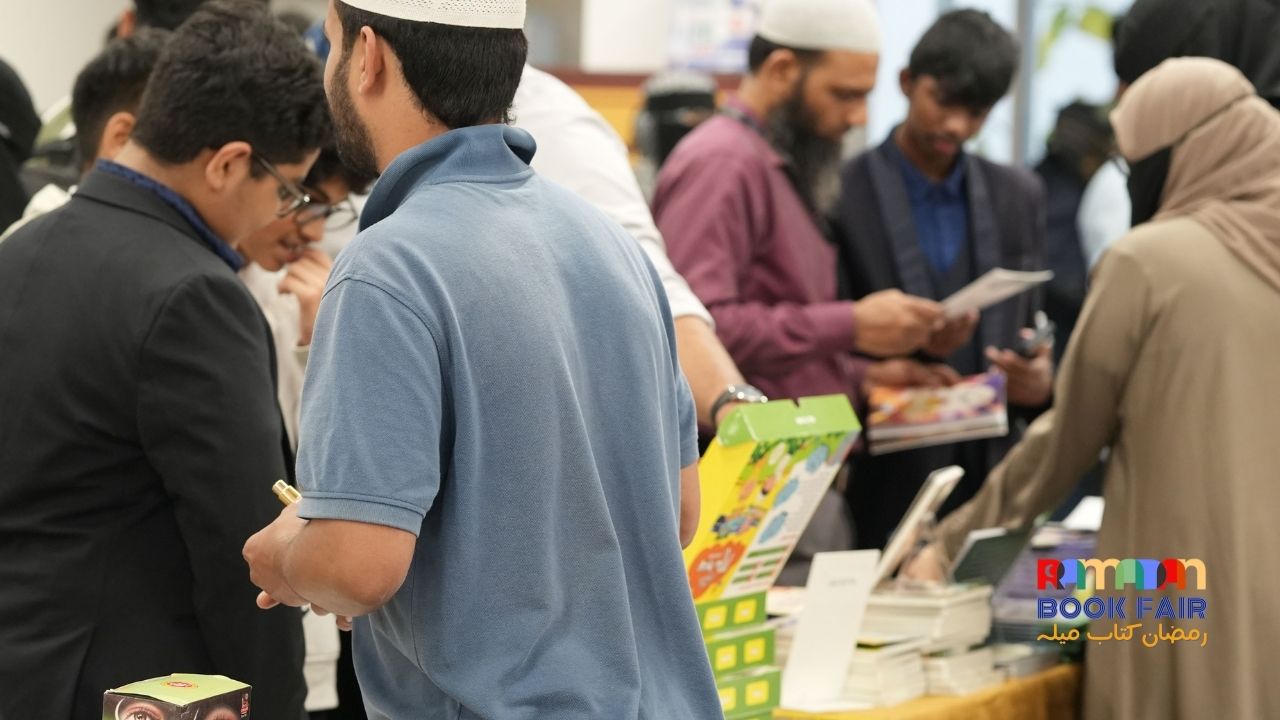
As organisers, we inevitably begin by looking at the big things: scale, impact, numbers. And yes, the numbers were beautiful. A footfall of somewhere between 2,000 and 2,500 people over the course of the Ramadan Book Fair, far beyond what we had imagined, especially given that this was our first time. Alhamdulillah. But if we are honest, what truly settles in the heart are not the numbers. It is the small moments. The quiet, unexpected scenes that make every late night, every logistical challenge, every ounce of effort feel worth it.
Even before the fair began, something remarkable happened. One of the local masajid dedicated an entire khutbah to the importance of reading. We remember remarking among ourselves that in all our years, we had never attended a khutbah focused solely on reading. After the khutbah, an announcement was made inviting people to the Ramadan Book Fair. That moment reminded us that change often begins before the event itself, in conversations, reminders, and subtle shifts in thought.
Even before the fair had formally begun, messages started pouring in from across the country, from Kolkata to Chennai, Mumbai to Hyderabad, Kerala and even Delhi, asking when the fair would come to their city. Hearing these names one after another reminded us that the longing for such spaces is not isolated. It lives in many hearts, across many cities.
Another moment that stayed with us was watching people leave with bags full of books. What a sight that was. We are so accustomed to seeing bags filled with clothes, food, or shopping hauls. But watching families, children, and adults walk out carrying books, heavy with ideas, words, and possibilities, felt deeply symbolic. It felt like a quiet reclaiming of something we had lost and were slowly finding again.
One particularly powerful moment unfolded during a panel discussion when a ten-year-old child stood up and asked the authors, “How do I motivate myself to read, and eventually write?” That question alone felt like a victory. This was exactly what we had hoped for, to create a space where engagement feels natural, where children and adults alike feel confident enough to ask, reflect, and dream. A space where the actualisation of the ʿaql is not merely spoken about, but visibly unfolding.
There was also, as there often is, pressure to charge an entry fee. But collectively, we stood our ground. We felt strongly that access should not be a barrier, and that knowledge, conversations, and exposure should remain open. Looking back, that decision shaped many of the moments that followed.
One phone call, in particular, stayed with us. A friend shared that her house help wanted to bring her children to the fair. When she first heard about the event, her immediate response was, “Hamare liye kaun sochta hai?”, who ever thinks about people like us? She assumed it would be ticketed, as most such spaces are, especially for families. When she was told that the entry was free, the talks were free, and that even the books were available at subsidised prices, she offered heartfelt duas, and she came. With her children. They listened, they engaged, they browsed, and they took books home.
Perhaps that is what stays with us most, these quiet affirmations that inclusivity is not merely a value we speak about, but something that can be practised. That reading can be made accessible. That spaces can be created where dignity, curiosity, and learning meet, regardless of background.
Another deeply affirming sight was the way people showed up as families. Parents did not merely attend; they involved their children, asking whether their fifteen-year-old sons could help with registrations, or whether their daughters could volunteer in any capacity. Husbands came along, waited patiently, stepped in wherever help was needed, moving tables, managing logistics, and offering quiet support. It was beautiful to witness this shared sense of responsibility and presence. This is what a healthy community looks like, families supporting one another, standing together, and contributing collectively towards a larger purpose.
Equally moving was witnessing institutions uplift one another with genuine sincerity. Businesses gave shout-outs to fellow businesses, schools supported and celebrated each other’s work, and the space became what it was always meant to be, a melting pot of collective effort and mutual encouragement. There was no sense of competition or insecurity, only collaboration, presence, and a shared intention to serve. It was humbling to watch people simply show up for one another.
At the heart of it all stood a large, committed family of volunteers who came together with remarkable resilience. They stood through the storm, burned the midnight oil, and poured their time, energy, and strength into this cause, to revive the true essence of Ramadan and to bring the culture of reading back into our lives. Their contribution goes far beyond what words can adequately acknowledge, and this fair stands as a testament to what becomes possible when a community works not for recognition, but for meaning.
We were also deeply moved by those who travelled from different cities, and even across states, to be part of the Ramadan Book Fair. Some journeyed overnight, purely out of intention and love for learning, to attend conversations, engage with books, and simply be present. Many became quiet ambassadors of the fair, spreading the word, inviting others, and carrying its spirit forward through sincere word of mouth. It reminded us that when something is rooted in purpose, it travels far beyond geography.
One of the most moving moments for us, one that brought tears, came through a quiet conversation with a sister who had lived much of her life across different countries. A teacher and mentor by calling, she had moved to Bengaluru a few years ago carrying a simple yet profound dua, to belong to a vibrant community where her children could grow, offer their skills, feel rooted, and where she herself could contribute meaningfully. She shared how she would often ask Allah, “Where is my dua? When will I see it actualised?” Standing there at the fair, watching her son and daughters engage and volunteer, while she herself contributed her skills, she said softly that this felt like her dua unfolding before her. To realise that we were part of someone’s answered prayer, SubhanAllah, is a gift no numbers or metrics can ever measure.
We were also blessed with a host beyond what we could have hoped for. Beary Amity’s Asif bhai not only opened his premises to us, but opened his heart as well. He brought his wife and daughter to stand with us in support, embodying hospitality in its truest sense. As the fair expanded across the basement, first floor, second floor, registration area, and required specialised access to the fifth-floor prayer hall and conference room, he met every request with patience, generosity, and quiet presence. This was not hospitality driven by formality, but by sincerity. Such rahmah cannot be repaid in words.
It takes immense trust to stand behind something that has never been done before. Sponsors such as Islamicly, Bushra Tours and Travels, and Ummeed Hospital placed their trust in an idea still taking shape, unique in vision, yet without numbers, outcomes, or guarantees. Nothing could be promised except sincerity of intention. That early trust holds a special place in our hearts, because belief at the beginning often carries more weight than applause at the end.
Equally humbling was the commitment of our panellists, speakers, moderators, and workshop leads. Despite demanding schedules, some travelled from Delhi, others from Hyderabad, while many came from different walks of life within the city. We are especially grateful to those who journeyed long distances at their own expense, and to everyone who offered their time, insight, and presence without expectation, measuring impact not by packed halls, but by meaning.
We were also supported in a deeply grounding way by a senior family member, a veteran event organiser with decades of experience, who arrived a day early and quietly took charge. He brought along his team, involved his sons, arranged materials, and guided us through layouts, stall construction, and logistics. Though family by relation, his contribution was professional, generous, and anchoring. For first-time organisers, this support was invaluable.
One of the most humbling things we witnessed was someone sharing that they had been at the lowest point of their life, asking Allah for a sign, and that sign unfolded through the Ramadan Book Fair. In that space, they found friendship, sisterhood, suhbah, and renewed hope. We saw people find mentors, meaningful connections, and even opportunities for work. It became more than an event; it became a doorway.
What stayed with us most was watching a young, vibrant community come together organically. Connections extended beyond the fair, collaborations formed, and circles grew. That ripple effect, people finding direction, purpose, and one another, is the impact we cherish most deeply.
Yes, the numbers mattered, and we remain grateful for them. But it was these moments, small, sincere, deeply human, that truly carried the weight of this journey.
We pray that any shortcomings or oversights are forgiven. Whatever khayr was present is only from Allah, and whatever was flawed was from us. May He purify our intentions and accept this effort despite its imperfections.
All praise belongs to Allah alone. Without His tawfiq, none of this would have unfolded. Alhamdulillahi Rabbil ‘alameen.
If this was the first chapter, it was written with sincerity, trust, and collective effort. We pray that this fair becomes not just an annual event, but a growing culture, one that restores reading, nurtures the ʿaql, strengthens suhbah, and reminds us that meaningful change begins when a community chooses to show up for one another.
We cannot wait to see you again.
Leave a Reply